Grades 7, 8 & 9
SPEAK SPHERE
PUBLIC SPEAKING CHALLENGEARGUMENTATIVE SPEECH
Introduction
What would you choose?
Let's see where you stand!
Imagine yourself in these real-life situations. Each situation presents two different viewpoints. Choose the side you agree with!
Your Answers Have Been Submitted!
Ready to defend your choices?
Having an opinion is easy. But can you support it with logical reasoning, convincing examples and relevant evidence? Can you respond confidently when someone challenges your viewpoint?
Let's learn how to deliver an effective ARGUMENTATIVE SPEECH, where your opinions become well-supported arguments and your words have the power to influence others!
What is an argumentative speech?
- An argumentative speech is a type of speech in which a speaker presents an argument supported by proof and evidence.
- Its purpose is to convince the audience to understand and consider the speaker’s point of view.
- In the speech, the speaker also acknowledges different opinions and explains why their own position is stronger.

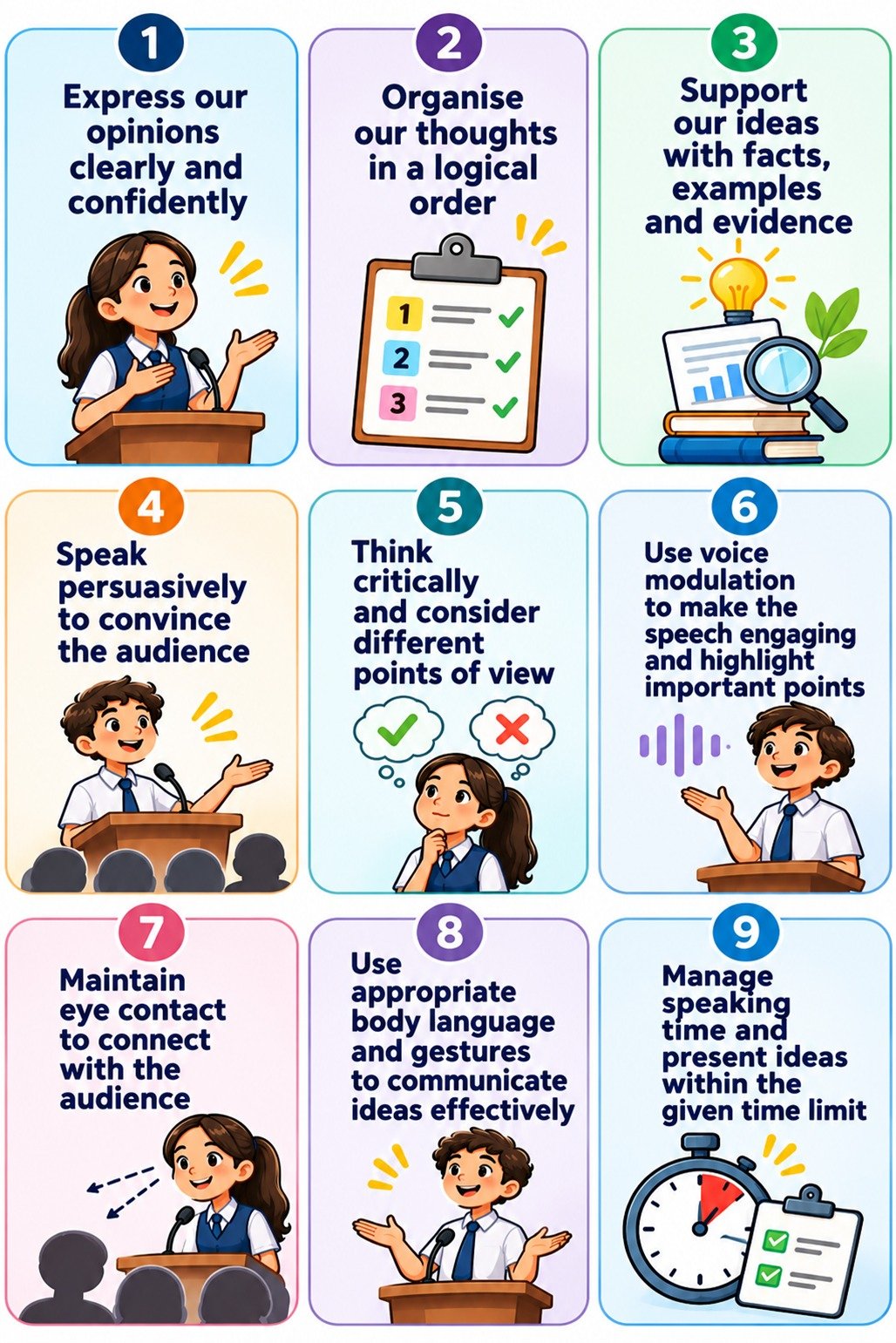
How does an argumentative speech help us develop public speaking skills?
An argumentative speech helps us develop public speaking skills by teaching us to:
How to prepare an argumentative speech?
An argumentative speech has five key parts that work together to build a well-structured and convincing argument.
Think of a burger being built layer by layer. Each ingredient adds something important to make the burger complete. In the same way, each part of an argumentative speech has a specific role in making your argument strong and effective.
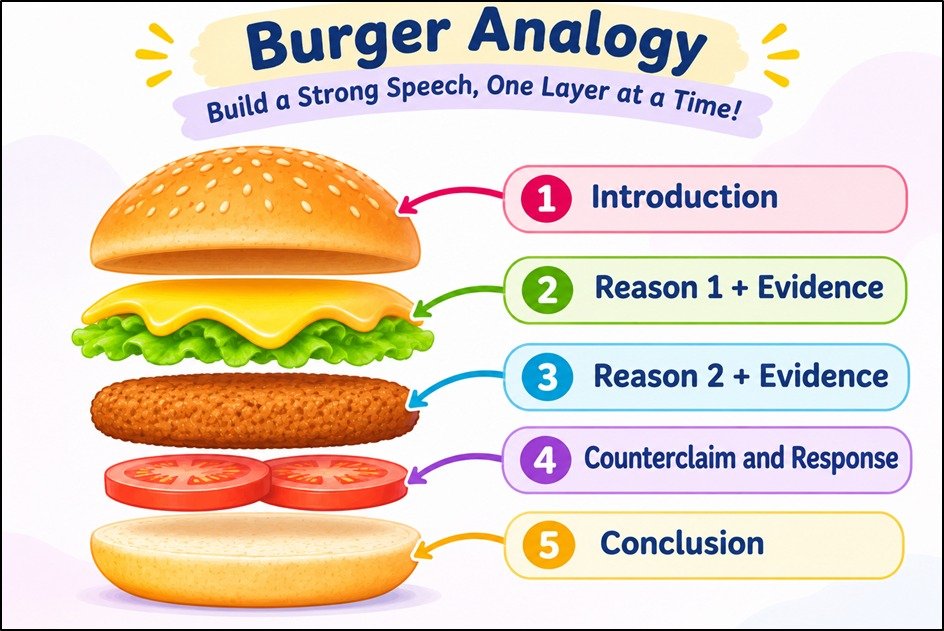
Let us explore each part in detail using the following topic as an example:-
Example Topic:
‘Reading printed books is more beneficial than reading from digital screens.’
Express your views either for or against this statement.
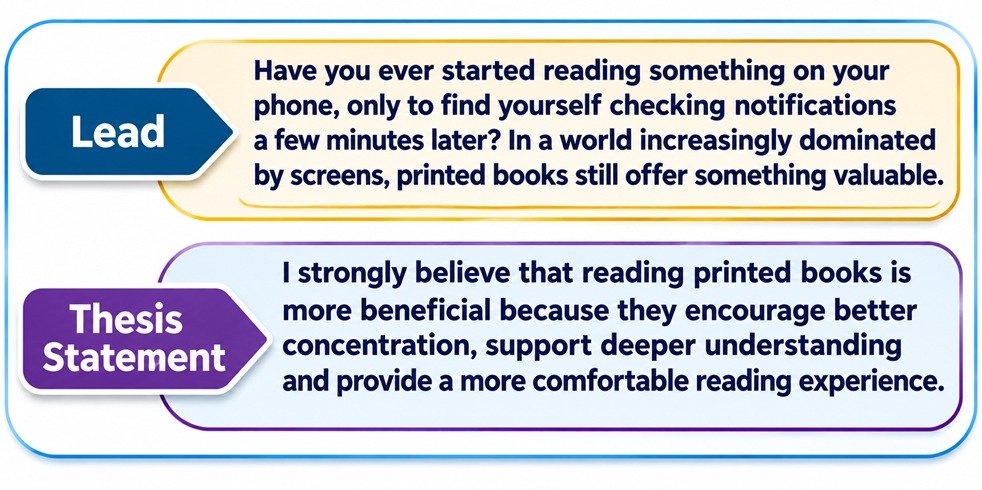
Step 1: Introduction: Lead and Thesis Statement
What to include:
- Lead: Begin with an interesting question, surprising fact, short statement or situation that catches the audience’s attention.
- Thesis Statement: Clearly state your position on the topic and give the audience an idea of what your speech will argue.
👀 Example
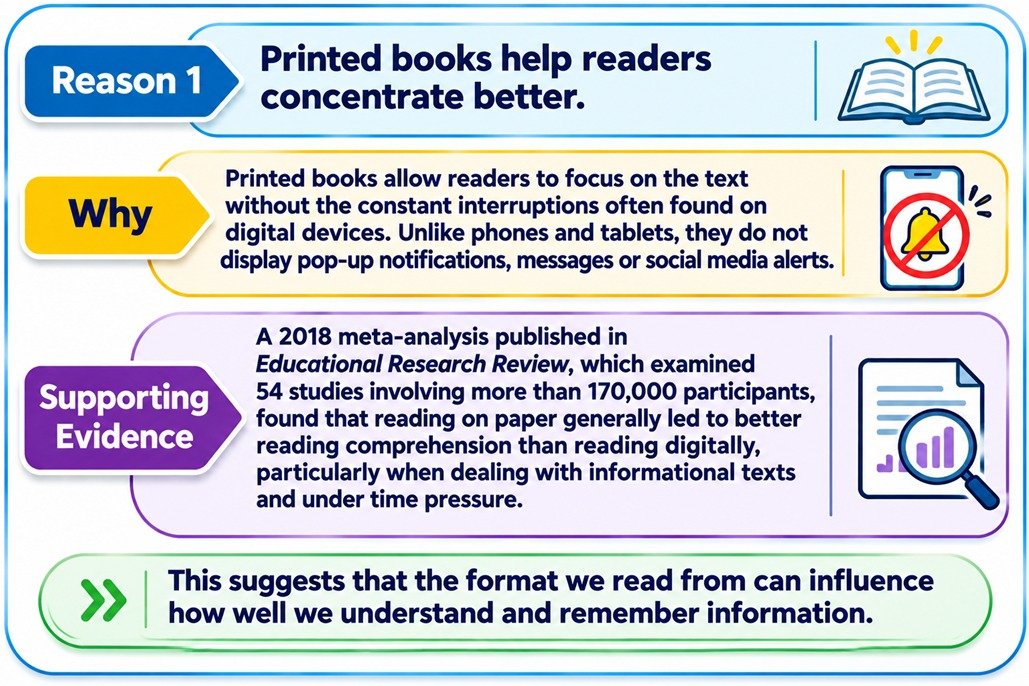
Step 2: Body: Reason 1 and Supporting Evidence
What to include:
- Present your first strong reason to support your position
- Explain why this reason matters
- Support your argument with facts, research findings, examples or expert opinions
👀 Example
Step 3: Body: Reason 2 and Supporting Evidence
What to include:
- Present another reason that supports your position
- Explain why it strengthens your argument
- Support your argument with relevant research, facts, examples or expert opinions
👀 Example
Step 4: Body: Counterclaim and Response
What to include:
- Acknowledge an opposing point of view (counterclaim)
- Explain why some people may support that viewpoint
- Present a response that shows why your original position is still stronger
- Support your response with facts, examples or evidence
👀 Example
Step 5: Conclusion: Summary and Strong Closing Statement
What to include:
- Briefly remind the audience of your main arguments
- Restate your position in different words
- End with a memorable statement, thought-provoking question, or call to action
👀 Example
Are You Ready?
Let's now combine all five steps and explore a complete argumentative speech from beginning to end!
Note: Introduce Yourself and State Your Stand: Begin by greeting the audience, introducing yourself and your grade, and clearly stating whether you are speaking FOR or AGAINST the given topic. Briefly express your position.
For Example: Good morning, everyone! My name is John, and I am a student of Grade 8. Today, I am here to speak in favour of the topic, “Reading printed books is more beneficial than reading from digital screens.” I strongly agree with this statement.
Have you ever started reading something on your phone, only to find yourself checking notifications a few minutes later? In a world increasingly dominated by screens, printed books still offer something valuable. I strongly believe that reading printed books is more beneficial because they encourage better concentration, support deeper understanding and provide a more comfortable reading experience.
Printed books help readers concentrate better. They allow readers to focus on the text without the constant interruptions often found on digital devices. Unlike phones and tablets, they do not display pop-up notifications, messages or social media alerts. A 2018 meta-analysis published in Educational Research Review, which examined 54 studies involving more than 170,000 participants, found that reading on paper generally led to better reading comprehension than reading digitally, particularly when dealing with informational texts and under time pressure. This suggests that the format we read from can influence how well we understand and remember information
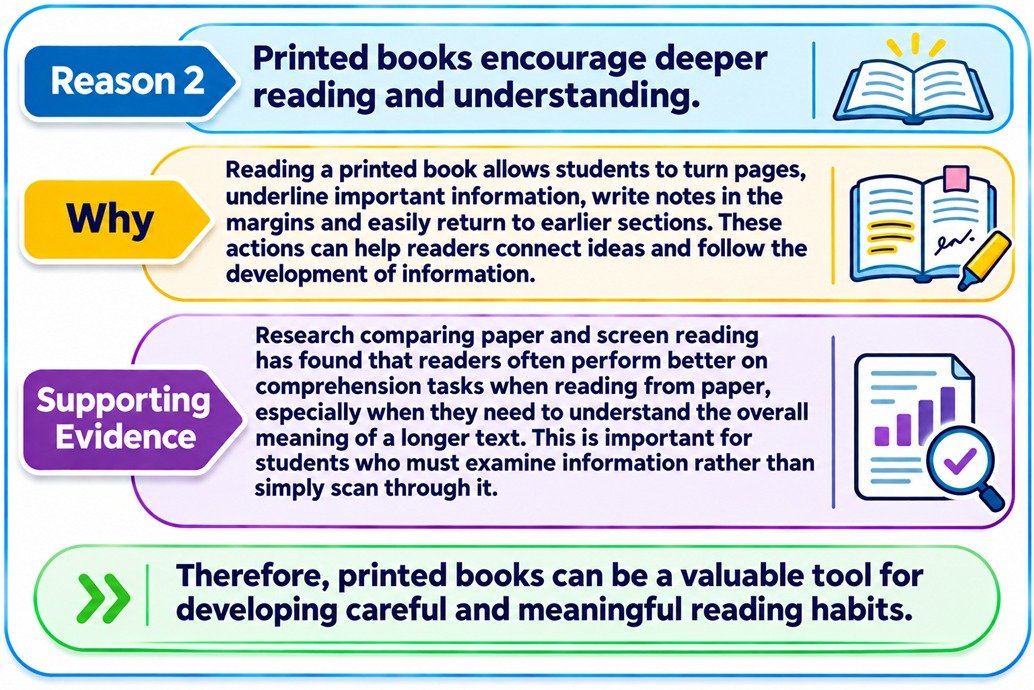
Printed books also encourage deeper reading and understanding. Reading a printed book allows students to turn pages, underline important information, write notes in the margins and easily return to earlier sections. These actions can help readers connect ideas and follow the development of information. Research comparing paper and screen reading has found that readers often perform better on comprehension tasks when reading from paper, especially when they need to understand the overall meaning of a longer text. This is important for students who must examine information rather than simply scan through it. Therefore, printed books can be a valuable tool for developing careful and meaningful reading habits.
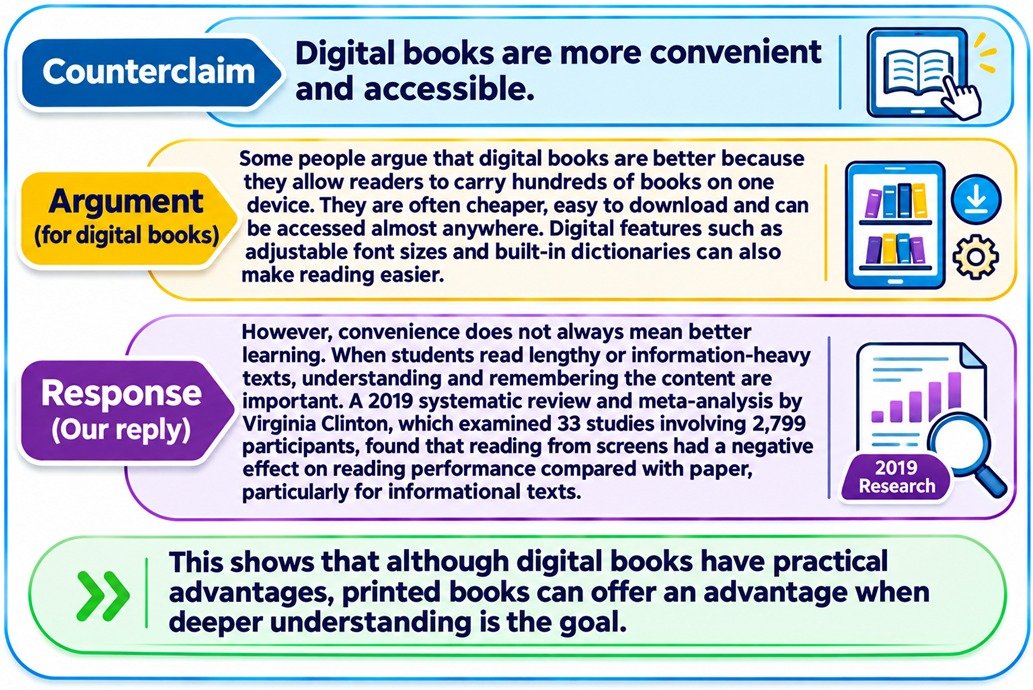
Some people argue that digital books are better because they allow readers to carry hundreds of books on one device. They are often cheaper, easy to download and can be accessed almost anywhere. Digital features such as adjustable font sizes and built-in dictionaries can also make reading easier. However, convenience does not always mean better learning. When students read lengthy or information-heavy texts, understanding and remembering the content are important. A 2019 systematic review and meta-analysis by Virginia Clinton, which examined 33 studies involving 2,799 participants, found that reading from screens had a negative effect on reading performance compared with paper, particularly for informational texts. This shows that although digital books have practical advantages, printed books can offer an advantage when deeper understanding is the goal.
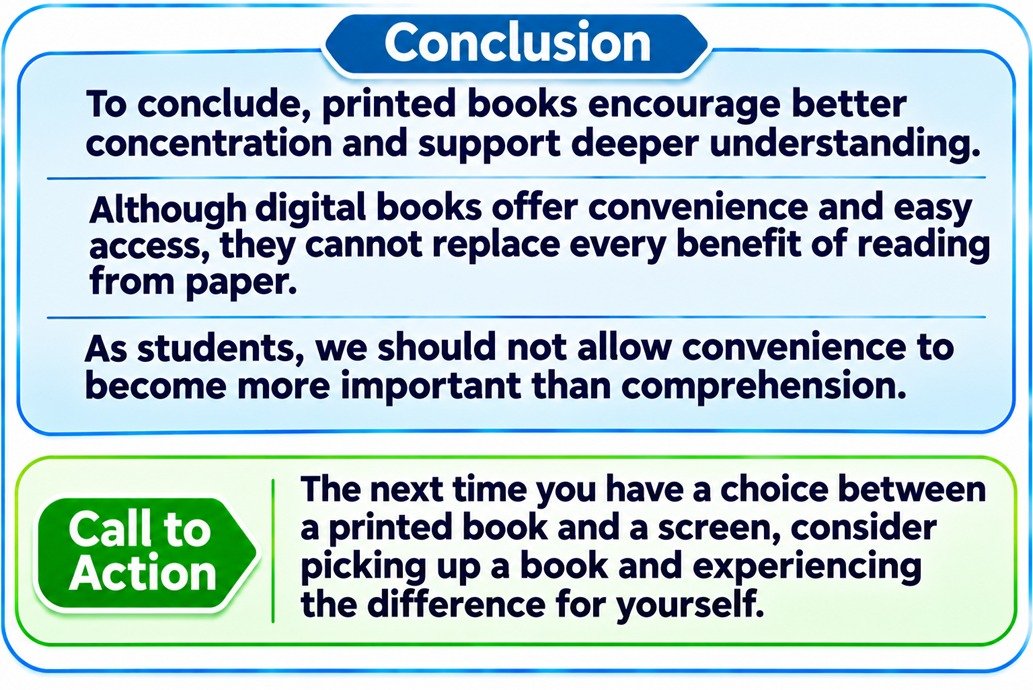
To conclude, printed books encourage better concentration and support deeper understanding. Although digital books offer convenience and easy access, they cannot replace every benefit of reading from paper. As students, we should not allow convenience to become more important than comprehension. The next time you have a choice between a printed book and a screen, consider picking up a book and experiencing the difference for yourself.
Presentation Tips
Since this is a public speaking competition, let's go through some important presentation tips to help you deliver your Book Talk confidently and effectively!
Know Your Rubric!
The rubric is a guide that shows how your argumentative speech will be scored on the day of the competition.
Think of the rubric as your writing checklist! Use it while you rehearse to check that your book talk includes everything you need.
Traits Rubric Grades 7, 8 & 9 (For Students)
(Total: 25 points)
| Beginning (1 point) |
Getting There (2 points) |
Good (3 points) |
Very Good (4 points) |
Excellent (5 points) |
|
|---|---|---|---|---|---|
|
A. Introduction & Conclusion
Key Question: Did I begin with an engaging introduction, clearly establish my topic and finish with a strong, memorable closing statement? |
I struggle to introduce my topic and capture the audience's attention. My speech ends abruptly without a clear conclusion. | I introduce my topic but my opening lacks impact. My conclusion is basic and does not leave the audience with a clear final message. | I introduce my topic and clearly communicate what my speech is about. I end with a suitable conclusion that restates my main message. | I begin with an interesting opening that captures attention and smoothly introduces my topic. I end by reinforcing my message with a meaningful closing statement. | I deliver a compelling introduction that immediately captures attention and establishes a clear direction for my speech. I finish with a powerful and memorable conclusion that leaves a lasting impression. |
|
B. Content and Quality of Arguments
Key Question: Did I present relevant and convincing arguments in a logical order, support my ideas and address the opposing viewpoint with an effective response? |
My arguments are unclear, weak or irrelevant. I provide little or no supporting evidence. My ideas lack structure, and I fail to address opposing viewpoints. | I present some relevant arguments, but they lack depth and sufficient explanation. My supporting evidence is limited or weak. My response to opposing viewpoints is underdeveloped. | I present relevant arguments with reasonable explanations and supporting examples or evidence. My ideas follow a logical sequence. I acknowledge the opposing viewpoint and provide a suitable response. | I develop clear and convincing arguments, using relevant facts, examples or research to strengthen my points. I explain my reasoning in detail and respond to the opposing viewpoint with a well-supported counterargument. | I present strong and convincing arguments supported by credible evidence. I demonstrate thoughtful reasoning, address the opposing viewpoint accurately and provide a strong response that reinforces my position. |
|
C. Language and Vocabulary
Key Question: Do I use precise vocabulary, varied sentence structures and appropriate language to communicate my arguments effectively? |
I use basic and repetitive vocabulary. My sentence structures are often unclear, and frequent grammatical errors make my ideas difficult to understand. | I use simple vocabulary and sentence structures. I make several grammatical errors and struggle to express complex ideas clearly. My language lacks variety. | I use appropriate vocabulary and generally correct sentence structures. I communicate my ideas clearly, with some variety in language and occasional grammatical errors. | I use varied and precise vocabulary, well-structured sentences and appropriate persuasive language. My grammar is mostly accurate, and I communicate complex ideas effectively. | I demonstrate excellent command of language through precise vocabulary, sophisticated sentence structures and effective rhetorical techniques. My grammar is accurate, and my language is fluent, persuasive and engaging. |
|
D. Audience Engagement and Confidence
Key Question: Do I speak confidently, connect with my audience and maintain their interest throughout my speech? |
I show very little confidence while speaking. I struggle to connect with the audience and fail to maintain their interest. | I show limited confidence and find it difficult to engage the audience. My delivery lacks energy, and I struggle to maintain their attention. | I speak with reasonable confidence and make some effort to connect with the audience. I maintain their interest during most of my speech. | I speak confidently and demonstrate good stage presence. I connect well with the audience and maintain their interest throughout most of my speech. | I demonstrate exceptional confidence and strong stage presence. I establish a natural connection with the audience, maintain their attention throughout and deliver my speech with energy and conviction. |
|
E. My Overall Presentation (Voice Modulation, Delivery, Body Language and Eye Contact)
Key Question: Do I use effective voice modulation, clear delivery, appropriate body language and consistent eye contact to communicate my message effectively? |
I speak unclearly or in a monotonous voice. I rarely maintain eye contact and show little attention to posture, gestures or facial expressions. | My voice lacks variation in tone, pace and volume. I make limited eye contact, and my gestures, posture and facial expressions need improvement. | I speak clearly and use some variation in tone, pace and volume. I maintain occasional eye contact and use suitable gestures and facial expressions. | I deliver my speech clearly with effective voice modulation. I maintain good eye contact and use natural gestures, appropriate posture and expressive facial expressions. | I demonstrate excellent control of voice modulation, pace, volume and pauses. My speech is clear and expressive. I maintain consistent eye contact and use confident posture, natural gestures and purposeful facial expressions to strengthen my delivery. |
How will the competition be conducted?
Students must prepare and rehearse an original Argumentative Speech beforehand. They should be familiar with their arguments, supporting evidence and counterarguments, and deliver their speech confidently during the competition without reading from a paper or written script.
Each participant will be given 2 minutes 30 seconds to 3 minutes maximum to deliver their speech. Participants should rehearse beforehand to ensure they complete their speech within the given time.
A list of 15 Argumentative Speech topics is provided below. Each participant must select one topic from the list and prepare an original speech, clearly expressing their views either FOR or AGAINST the selected statement.
Select Your Topic!
- ‘Online learning can be as effective as traditional classroom learning.’ Express your views either for or against this statement.
- ‘Documentaries are more valuable for learning than fictional films.’ Express your views either for or against this statement.
- ‘Modern lifestyles are making joint family living less practical compared to nuclear families.’ Express your views either for or against this statement.
- ‘Technology has made people less socially connected.’ Express your views either for or against this statement.
- ‘Every teenager should be required to perform community service.’ Express your views either for or against this statement.
- ‘Celebrities and influencers should be held responsible for the products they promote.’ Express your views either for or against this statement.
- ‘Social media platforms should have rules that limit what people can say and share.’ Express your views either for or against this statement.
- ‘AI will replace more human jobs than it will create in the future.’ Express your views either for or against this statement.
- ‘Food delivery apps have changed people's eating habits for the worse.’ Express your views either for or against this statement.
- ‘Artificial Intelligence makes it easier for students to learn but harder for them to think independently.’ Express your views either for or against this statement.
- ‘Modern convenience has made people less physically active.’ Express your views either for or against this statement.
- ‘Financial literacy should be a compulsory subject in schools.’ Express your views either for or against this statement.
- ‘Modern society places too much importance on physical appearance.’ Express your views either for or against this statement.
- ‘Students should be taught to question and verify AI-generated information rather than trust it.’ Express your views either for or against this statement.
- ‘Technology is developing faster than society's ability to use it responsibly.’ Express your views either for or against this statement.
Each participant will individually present their Argumentative Speech in front of the judges and audience. The participants should follow the argumentative speech structure taught in the study material.
Introduction :-
Lead and Thesis Statement
Body :-
Reason 1 and Supporting Evidence
Body :-
Reason 2 and Supporting Evidence
Body :-
Counterclaim and Response
Conclusion :-
Summary and Strong Closing Statement
Students will be evaluated on five traits, with each trait carrying a maximum of 5 points, for a total of 25 points. (Kindly check ‘Know Your Rubric’ section)
- Introduction & Conclusion
- Content and Quality of Arguments
- Language and Vocabulary
- Audience Engagement and Confidence
- Overall Presentation (Voice Modulation, Delivery, Body Language and Eye Contact)